The Invisible Executive: Experience Isn't the Issue, Visibility Is
Senior leaders often feel invisible in today's job market. The problem usually isn't your experience — it's how it's positioned. Here's how to shift the focus to relevance, passion, and business value.
The Executive Career Challenge Nobody Wants to Talk About
If you're a senior leader and your job search suddenly feels harder than it did five or ten years ago... it isn't your imagination.
Many accomplished executives quietly wonder whether their experience has become a disadvantage. The truth is more nuanced than that.
After working with hundreds of senior leaders, we've found that hiring managers often have unspoken questions they're trying to answer within the first few seconds of reviewing your resume or LinkedIn profile:
- "Will this person still be challenged here?"
- "Are they looking for a place to finish their career — or a place to make an impact?"
- "Will they expect more compensation than we can offer?"
- "Will they stay if another opportunity comes along?"
Whether those concerns are fair or not, they're real questions that can influence hiring decisions.
The Good News: Those Concerns Can Be Answered Early
Those concerns can often be addressed long before the interview — in your resume summary, your LinkedIn headline, and the first sixty seconds of any conversation.
The most successful executive candidates don't lead with decades of experience. They lead with relevance.
- They communicate why this challenge matters to them.
- They show genuine enthusiasm for helping this organization achieve its goals.
- They demonstrate that they have the freedom to choose where they invest the next chapter of their career — and they've chosen this opportunity because they believe they can make a meaningful difference.
That changes the conversation.
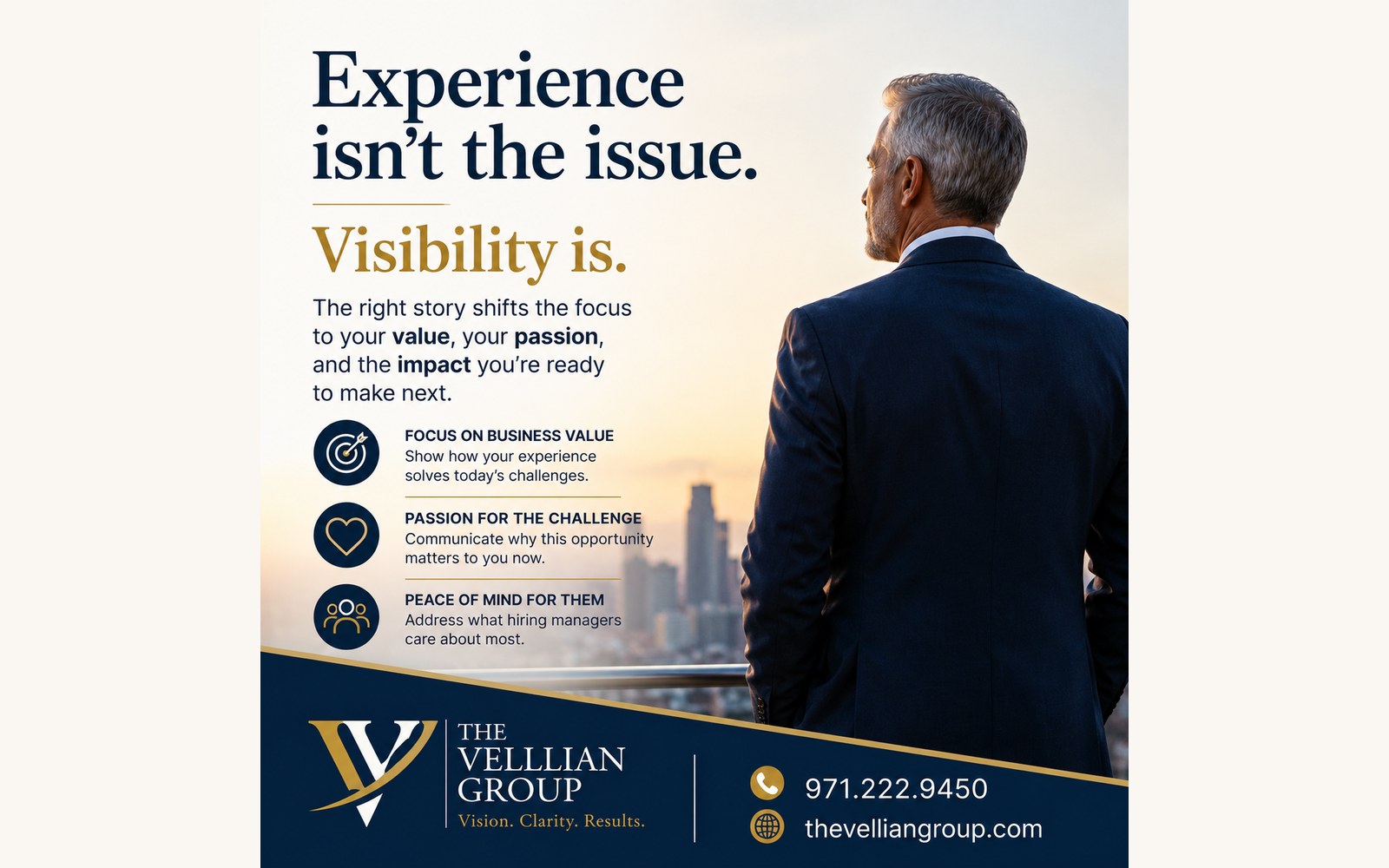
Experience Isn't the Issue. Visibility Is.
Your experience isn't just about what you've accomplished. It's about the value you're excited to create next.
Three shifts move the focus away from assumptions and toward business value:
1. Focus on business value
Show how your experience solves today's challenges — not how long you've been solving them. Replace tenure language ("25+ years of leadership") with outcome language ("turned around a $40M business unit in 18 months").
2. Lead with passion for the challenge
Communicate why this opportunity matters to you now. Executives who articulate a clear "why now" neutralize the retirement question without ever naming it.
3. Offer peace of mind
Address what hiring managers care about most: risk. Speed to impact, cultural fit, and willingness to roll up your sleeves all reduce perceived risk.
Where Invisibility Actually Happens
Most senior leaders don't get screened out in the interview. They get screened out earlier:
- The LinkedIn headline that lists a title instead of a value proposition.
- The resume summary that opens with years of experience instead of the problem you solve.
- A 20-year work history listed in full detail, when the last 10–15 years carry the story.
- A dated digital presence — no photo, no activity, no evidence of current thinking in your field.
LinkedIn is the first place employers look for information about you, even when they already have your resume. Your profile and your resume work together as a power couple; a great profile can't be built on a weak resume, and a great resume rarely gets found without a strong profile.
An Example of the Shift
Before: "Seasoned operations executive with 28 years of progressive leadership experience across manufacturing and distribution."
After: "Operations executive who scales distribution networks under pressure — $120M P&L, 4 plant integrations, 22% cost reduction in 3 years. Focused next on mid-market manufacturers modernizing their supply chain."
Same career. Completely different read.
The Goal Isn't to Look Younger
The goal isn't to convince employers that you're younger. The goal is to make your relevance, passion, and future contribution impossible to ignore.
The best storyteller wins.
Frequently Asked Questions
Is ageism in executive hiring real?
Age discrimination is illegal, but unspoken assumptions about compensation expectations, tenure, and energy do influence hiring decisions. The practical response is to answer those assumptions proactively through positioning rather than to argue with them.
Should I remove dates from my executive resume?
Rarely. Instead, focus the detailed content on the last 10–15 years and summarize earlier roles in a brief "Earlier Career" section. This keeps the resume honest while directing attention to your most relevant work.
How do I stop feeling invisible in my job search as a senior leader?
Visibility comes from a positioned LinkedIn profile, a resume built around outcomes rather than tenure, and consistent, low-maintenance activity in front of the right audience. Most of our clients maintain it in 20 minutes a week once it's set up.
How many years of experience should an executive resume show?
Detail the most recent 10–15 years. Older roles belong in a condensed section that establishes your foundation without diluting your current relevance.
Can a career coach help with executive job search after 50?
Yes. The work is positioning, storytelling, and search strategy — the same levers that determine whether your experience reads as a risk or an advantage.
Ready to make your relevance impossible to ignore? Schedule a discovery call with The Vellian Group and we'll map out the positioning strategy for your next chapter.
Ready for your next step?
Schedule a discovery call with The Vellian Group.
Schedule a Discovery CallWant help with your LinkedIn headline?
Leave your name and email — Heather will personally reach out within 1 business day to book a free 30-minute discovery call.
All requests are kept strictly confidential. We only use your info to schedule your discovery call. No spam, ever.
Related articles
More insight on executive career strategy.

Senior Leaders: Don't Be Invisible During the Fall Hiring Surge
The September Surge is one of the strongest executive hiring windows of the year. Here is how senior leaders position experience, refresh an executive resume, and optimize a LinkedIn headline before the right opportunity appears.
Read article →
LinkedIn Headline Examples: Update Yours Weekly to Get Found (Executive Job Search Guide)
The best LinkedIn headline isn't written once — it's refreshed every week. Executive-level LinkedIn headline examples, a proven formula, and the weekly job search habit that quietly beats every competitor in the search results.
Read article →
The Best Storyteller Wins: Turn Career Adversity Into Your Greatest Qualification
The layoff, the failed business, the leadership mistake — the experience you think disqualifies you is often what qualifies you. Here is how to tell that story on your resume, LinkedIn, and in interviews.
Read article →